Tuesday, November 15, 2011

The Walters: Responsible Dog Owners Since 1986

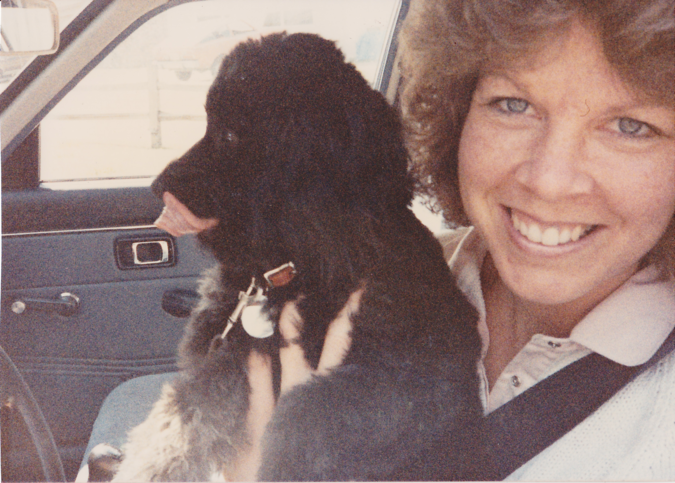
Cody Walter (July 1986 - October 2000) and Carol Walter (May 1953 - March 2000)

The back of this photograph says "Cody on the way to his last day of obedience class!" I believe this is my grandmother's car, it's the only car I remember that had manual windows. Cody's Obedience Diploma was framed and hung above his dishes in the laundry room.

Tuesday, November 8, 2011

Dunning-Krueger Effect

...is pretty much my life. My fatal flaw is huge ego, no work ethic. I habitually talk big about things I know nothing about, always assume I'm right, and generally make an arrogant ass of myself on a regular basis. So please, take the following as it is intended: a need to get thoughts out of my brain so I don't lose the brilliant insight I just had, and in three months come back and wallow in how stupid and foolish I was.

I'm going to take a break from talking about dog training, which I have actually done a little, and talk about dog breeding, which I definitely know nothing about. I don't think I've ever actually touched a pregnant dog.

One of my hobbies is collecting and reading old dog books. I recently borrowed two on dog breeding from my kennel club's library.

Assuming they are indicative of the mindset of the time, the goal of breeding purebred dogs was to breed perfectly predictable animals. One book takes it to the logical conclusion and suggests that a truly "Pure" dog would be homozygous for every gene. AA bb XX, but not Aa bb Xx. Conceptually, if you selected the most fit alleles to breed for, you could have a perfect super dog that was the picture of breed type, healthy, and robust.

As the understanding of genetics has advanced, it has become clear that this is not only likely impossible (due to incomplete dominance and co-dominance, as well as polygenetic inheritance and mutation), it is a bad goal. In an extremely specialized environment - like laboratory or Antarctica extreme - it's possible that a completely Pure population of animals might survive or even thrive. When the window of survivability is narrow, minor variations are quickly extinguished. Low genetic diversity might keep the population more robust.

This is nothing like the environment we keep dogs in. Looking at the United States dog population as a whole, there is a huge amount of variability in the environments. Some homes are hot, some are cold, some cycle through both regularly. Some cycle through both irregularly. Some homes are active, some are inactive. Some are experienced homes, some are inexperienced. Some homes want highly specialized and predictable behavior patterns, some want generalized behavior and some want diluted behavior altogether. Lepto is a problem in some areas but not others. Conceivably, there should be enough genetic diversity across all dogs for there to be a dog to fit nearly any environment.

The value of well-bred dogs is predictability, not purity. Purebred breeding is a means to that end, not a goal in and of itself. If purity was the goal, Gatsby would be a valuable dog. I love the dog, but it's criminal that a dog like him was brought into the world on purpose.
Saturday, October 15, 2011

What I Want

I want a training system that works for 90% of dogs, and has the ability to deal with the outlying 10%.
I want a training system that a novice can apply to their dog and get a safe dog.
I want a training system that an expert can apply to their dog and get an excellent dog.
I want a training system that has a low risk of fallout through well-intentioned misuse.
I want a training system that is structured enough to not leave dogs or people guessing about what comes next.
I want a training system that is flexible enough to be used for any sport, work, or behavior.
I want a training system that is internally consistent.

Monday, October 10, 2011

The Dogs Win

Bad R+ training is ineffective and creates bad habits.
Bad R- training is abuse.

Tuesday, August 23, 2011

Theory and Practice

The role of academia and texts in dog training is to allow new trainers to stand on the shoulders of giants. Dog training must always be based upon the actual training of real live dogs, but saying "you will understand with more experience" is not an acceptable response from a mentor to an apprentice. The foundation of mentorship is to keep someone else from wasting time making the same mistakes you did so that they might surpass you in ability.

Counterpoint: The teacher appears when the student is ready. I am a young, idealistic and modern person with a bias to having access to unlimited knowledge at my whim, without qualification. You cannot own knowledge until you earn it, and being told facts is not the same as internalizing knowledge.

Friday, August 19, 2011

It Just Bugs Me

"If I offered my dog a treat for herding the cattle, she would look at me like I was crazy."

This is because positive reinforcement training is not about treats. It's about REINFORCEMENT. If giving your dog treats is not increasing behavior, treats are not a reinforcer.

ALL DOG TRAINING IS ABOUT REINFORCEMENT

If you want your dog to do things, you need to use reinforcement. Positive or negative, behavior comes from reinforcement. Think about how your training paradigm uses reinforcement, and you will instantly understand how to put it into practice better. Success builds on success. Even if you are using corrections, they are meaningless unless the dog can succeed at the task following the correction. The important part about the choke chain is not when it is tight, it is when it is LOOSE.

"Some dogs just need corrections."


What bothers me about this is not so much that dogs are being corrected, it's the implication that if you bolt away from the dog so that he flips over and is dragged five feet, the dog will now instantly respect you and all your training will go swimmingly from that point on for ever and ever until you ride off over the rainbow together on matching unicorns. I am not against dogs getting physical corrections, provided the correction is administered within a system that the dog understands. I am against training that doesn't do anything, that only addresses the behavior in the moment and not the behavior in the future.

Corrections are not ABOUT punishment. They ARE punishment, in the psychologist's use of the term ("don't do that"), but what makes a correction more than just punishment it that puts the dog back in correct action; the sit correction is a sharp jerk upwards because it will cause the dog to sit and thus be correct (this chain is an example of P+ -> R-, since the collar is tight when the dog is not sitting (P+) and loosens when the dog is sitting (R-)). A correction is punishment with information about how to receive reinforcement. It's the difference between a teacher marking the wrong answer in red, and marking the right answer in red.

Tuesday, August 16, 2011

Commands For Agility

Directionals
BINGO - Release
GO - Drive forward on your path, taking any obstacle directly in your path
COME - Turn towards me and drive to my front
HERE - Move laterally towards me, taking an obstacle on my side if there is a choice
OUT - Move laterally away from me, taking an obstacle away from me if there is a choice
SWITCH - Change leads to curl towards me, rear cross
FLIP - Change leads to curl away from me
MARSHMARSHMARSHMARSHMARSH - Come

Obstacles
WALK IT - A-Frame, Dogwalk
TIP IT- Teeter
STICK IT - two on, two off
SPOT - Table with auto down
TUNNEL - Tunnel
CHUTE - Chute
WEAVE - Weave poles